Writing Isn’t Real Work

I just had a brilliant idea. I will move my writing desk into the bathroom. That seems to be the only room in the house where respect for privacy still exists. If someone knocks on the bathroom door, I’ll shout, “I’m in here!” and they will go away. It’s not that easy when I’m in my writing room.

Yes, I have a room of my own – just for writing. It’s my only indulgence. I don’t get my nails done or color my hair, and I rarely spend money on clothes. Some women probably have closets bigger than my writing room. But I’m happiest here – sitting at my oak desk, gazing out the window at the ducks in the canal and the birds bobbing in and out of the maple tree – daydreaming, thinking and, sometimes, actually writing.

When I was working full time, and using this little corner of my bedroom as an office, no one seemed to care that I was in here all night reconciling bank accounts and working up spreadsheets. No one bothered to stop in to see if I had eaten or slept in the past 24 hours. If someone knocked on the door, I shouted, “I’m working!” and they left me alone.

Now that I’ve cut back my workload and decided to spend more time writing, I put away the adding machine, stowed the work files in a cabinet, and redecorated the room. I consulted a feng-shui book and moved some things around for optimal flow of chi. The desk was placed under the window so I could gaze out on the canal, since water is supposed to spark creativity. I put down a small oriental rug, hung some of my son’s paintings on the wall and lined the window ledge with seashells. The shelves are filled with poetry books, memoirs and writings by my favorite authors.

If we ever sell this house, it will be on one condition: that I get to take my writing room with me. That’s how much I love being in this room. I call it “My World.” Problem is, everyone else likes to be in here too.

“You’ve got the best room in the house,” my son said, as he sat in the corner rocking chair, admiring a glass jar filled with my collection of igneous rocks. “How come you get the best room in the house? Where’s dad’s world?”

“Dad has the garage.”

“The garage?”

“And the lawn.”

“But dad works on the lawn.”

“I’m working up here too,” I said.

“You’re not working up here; you’re writing.”

“And I’m not even writing, because you’re disturbing me. Now, GET OUT!”

Most of my conversations with family members end on a similar note when they invade my writing space. I’ve tried other, more subtle, approaches to assert my privacy, but subtlety doesn’t give me the results I want.

When I converted my office space into a “Writing Room” I told everyone, “If the door is closed, assume I am writing. Don’t disturb me unless the house is on fire or someone is bleeding.”

Despite the ground rules I set forth, they still knocked on the door.  Here is a conversation I have with my husband at least once a week:

Knock, Knock

“Is the house on fire?” I ask.

“It’s 6:45. What time are we eating?”

“I don’t know; I’m writing.”

“Do you want me to order something?”

“Yes; order something.”

“What do you feel like having?”

“I can’t think about that now; I’m writing.”

A few minutes later – –

knock, knock.

“Is someone bleeding?” I ask.

“Where are the take-out menus?”

I like to think of my writing as real work. Ok, I’m not hauling bricks in the hot sun or slapping tar down on a roof. I’m in the comfort of my own home, in the nicest room in the house, sipping coffee and noshing on Lindt chocolate balls, but I’m still working. No one takes me seriously, though, because I’m not making any money at it.

Several years ago, I sold a short story to a magazine for $450. That was a real breakthrough for me; getting paid seemed to validate my time spent up here writing. After that publication came out, I was encouraged to spend more time writing, and instead of asking me, “When will dinner be ready?” my family asked me, “What are you working on now?”

But fame is a fickle woman and soon the interruptions began again. To deter the knocking before it began, I hung a sign on the outside of my door in 72-point font that said:
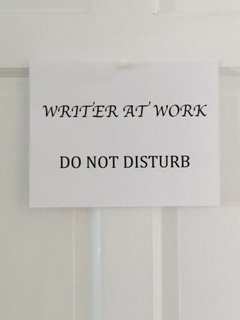
Writer at work signNow, instead of knocking, they simply barged in.

“Didn’t you see the sign on the door?”

“Yeah, it’s cute.”

“Did you read the sign? It says I’m working.”

“But you’re just writing.”

I tried locking the door, but they still knocked, and when I didn’t answer, they jiggled the handle and now the door is out of alignment. My husband mounted an old boat latch-hook to hold the door closed, but it doesn’t close tightly enough. There is just enough room for the tip of a nose and one eyeball to peer through the crack to see if I’m seriously writing or just goofing around on Facebook.
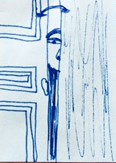
peeking in the doorIt wouldn’t matter if I was writing the next Pulitzer Prize winning novel because, obviously, whatever is happening outside my writing room is much more important than what I’m working on.

Like this crisis – –

“Do we have any vacuum cleaner bags?”

“I’m writing!”

“I just want to know where the vacuum cleaner bags are.”

Or this emergency that was sent via text message –

Mom! Can I eat those blueberries in the fridge, or are you saving them for a pie?

Or how about this bomb that my husband dropped on me one Sunday afternoon, as I was trying to finish an assignment for a Monday morning class…

“I see you have an oven stuffer roaster in the refrigerator. If you’re cooking it tonight, can I invite my father over for dinner?”

There are times when I pray for rain on the weekends. My husband, who checks the tides and the weather more often than a professionally paid meteorologist, will give me the forecast on a Friday night. Sometimes I get lucky. 

“It’s going to be a washout this weekend. Damn!”

“Oh no!” I put on my mopey face and pretend that I’m so disappointed the sun won’t be shining. “I guess I’ll hole myself up in my world  for the weekend and get some serious writing done.”

“I’ll clean out my closet,” he says, with the voice of a doomed man.

I love rainy days; I always have. The tender melancholia that envelopes me on a darkened rainy day brings out the deep introspection I need for the creative writing process. Rainy days are my sanctified gift from Mother Nature, my free pass from all outdoor recreation and a guarantee of uninterrupted writing time.

But sometimes Mother Nature disappoints me, and the rain clears out earlier than expected, or it doesn’t arrive at all. Then, you guessed it –

knock knock…

“Is the house on fire?” I ask. “Is someone bleeding?”

“It’s a beautiful day outside. Do you want to do something?”

“I’m already doing something; I’m writing.”

“Are you going to do that all day?”

“Probably.”

“Don’t you want to go outside? How can you stand being indoors when the sun is shining?”

“Sure, just give me a minute. First, I want to measure my desk to see if it will fit in the bathroom.”

Posted in Uncategorized | Tagged , , , , , | 5 Comments

XX Disappointment

The granddaddy of all disappointments, for me, began at my conception, when two X chromosomes hooked up and determined my sex. If I had any control over the matter, I would have urged that egg to hold out until a sperm carrying a Y chromosome came swimming by, thus creating a Christopher, instead of Christine.

By the time I was born, in 1952, society had already drawn up my life’s trajectory. It wouldn’t matter if I developed a mind like Clarence Darrow, an imagination like Albert Einstein or the talent of Vincent Van Gogh, because I had those damned XX chromosomes.

Growing up in the 1950s, there weren’t many career choices for little girls to dream about. It was assumed that every little girl’s single most important goal in life was to become someone’s wife and mother. Girls were rarely asked, “What do you want to be when you grow up?” And if your answer was anything other than the predictable career choices of nurse, teacher, secretary or airline stewardess, people looked at you with their heads cocked sideways– like a dog that doesn’t understand what you’re saying.

There weren’t many female mentors, or trail blazers to follow, for a little girl growing up with the foresight or the drive to be a doctor, a lawyer or an astronaut. And no little girl in the 1950’s would ever have imagined saying, “I want to be President someday.” Only boys could make those audacious statements and be praised for their high ambition.

More important than career choice, is the inherent freedom that boys are born with – to go anywhere and do anything without the burden of fear that is instilled in a little girl’s mind – that we can get hurt in ways that boys can’t.

Don’t drive alone at night; Don’t walk alone in the streets at night; Make sure someone walks you to the car if you have to work late; Don’t get off the subway alone in that neighborhood; Don’t go (on that road trip, traveling through Asia, to the mall, anywhere) by yourself; You’re asking for trouble if you wear that outfit in public.

So many warnings and restrictions accompanied me through my life that I sometimes feel I’ve lost opportunities for adventure, exploration and personal growth that I wouldn’t have had to give up if I was born with a set of XY chromosomes.

Even the Catholic Church had it in for us girls. Back in the 1950’s, altar servers were called “Altar Boys” for a reason. When I was preparing for First Holy Communion, at the young age of seven, I asked a nun why girls couldn’t be altar boys. She said, “Girls are not allowed to step on the altar because girls are impure.”

I didn’t know what “impure” meant until I was given that little pamphlet, Growing Up And Liking It. It should have been called Growing Up – Whether You Like It Or Not, for therein were the cold hard facts about the phenomenon of menstruation – the gentle sloughing off of uterine cells that occurs monthly, and is a precursor to the joys of becoming a woman. Soon your body will be changing – becoming more womanly, the booklet said.

It sounded like such an adventure, a passage into unknown lands – womanhood! I thought I was going to shed my twelve-year-old body overnight, like a cicada, leaving behind an empty shell of my formless shape, and emerging with a body like Marilyn Monroe.

Growing up and liking it

Well, there was nothing gentle at all about the entire process. After one day of agonizing cramps that made me curl up in bed, writhing like a caterpillar who’s been poked with a stick, I cursed the day those XX chromosomes united. I had no interest in becoming a woman, and would have made a deal with the devil to change places with the ugliest, dorkiest, overweight, unpopular boy in school just so I wouldn’t have to go through another month of the joys of becoming a woman.

For those of you who say only women can have the sanctified powerful life-giving miraculous experience of pregnancy, childbirth and motherhood, I agree. But for nine months I watched my body transform from a pretty, toned, size 5, happy young woman, into a cranky shrew distorted into the shape of a hideous unrecognizable leviathan.

And when it came time to deliver my little miracle, I would much rather have switched places with my husband and have him lying on that table, so that I could be the cheerleader standing behind his head shouting, “Come on, honey! Push! You can do it!”

God wasn’t kidding when he said to Eve, “I will greatly multiply your pain in childbirth, in pain you will bring forth children; yet your desire will be for your husband, and he will rule over you.” The pain was bad enough. Did he have to throw in that zinger at the end?? Proof that God had it in for us women from the start.

The Orthodox Jews have a morning prayer that translates: Blessed are you Lord…for not making me a woman.

I much prefer what the queen had to say about the matter.

“Balls!” she said. “If I had ‘em I’d be King!”

Posted in Uncategorized | Tagged , , , , | 1 Comment

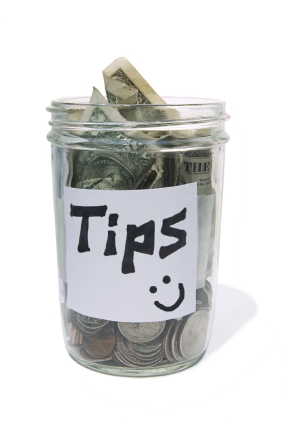
Working For Tips

There is a movement gaining traction in the restaurant industry to take servers off the current tip based payment system and put them on a salary. Higher salaries would mean a higher food bill for the customer, but a fairer pay scale across the board for servers and cooks.

Removing the optional tip on food bills would also eliminate the “punishment” that servers sometimes incur in the form of low tipping or no tipping patrons who are unsatisfied with their meals or their servers performance.

I know first hand what the “punishment” for poor performance looks like: it is a table full of dirty dishes and no tip hidden under the plates.

Back in high school I had a good friend who was a waitress in our local diner. She offered to train me so I could take her place on the breakfast shift and she could move up to the lunch shift. My friend persuaded the owner to hire me by telling him that I had “a little experience” in waitressing and she would take full responsibility for my training.

The boss knew what we were up to, but he liked my friend, and she was a good waitress, so I guess he thought I would turn out the same way. “You can’t do much damage with breakfast orders,” my friend told me. “Breakfast is an easy shift to learn on.” But no matter how much she tried to boost my confidence, I still goofed up.

People would order the #2 Special: 2 eggs, toast, bacon or sausage, juice and coffee or tea, and I would forget to ask them how they wanted their eggs. I would forget the coffee creamer, or the juice. No one ever got coffee refills. Wasn’t one cup enough? Besides, I had other customers to take care of.

I knew I was losing control of my tables when multiple people from different ends of the restaurant would call out: “Miss, you forgot the juice,” or “Miss, can I get my coffee now?” At those moments my friend would run over with a coffee pot and refill the cups, put juice and waters on the table and quiet everyone down before the boss would notice.

One morning, she put me on the counter. “This will be easier for you,” she said. “But you’ll have to learn to make coffee.” As the counter waitress, I was responsible for making sure the huge coffee urns were always full. There could be no lapse in the morning coffee supply, and it took at least ten minutes for the coffee to drip down into that behemoth coffee urn, so there had to be one full machine to draw from and one in the brewing process at all times.

As the counter started filling up, I forgot about the coffee machines, until I turned the spigot and nothing came out. I tried the other urn, but that was dry too. “Sorry; we’re all out of coffee,” I told two police officers waiting for their breakfast order. “It’ll be another fifteen minutes or so.”

“What?! No coffee?” I thought they were going to shoot me. People at the counter heard them and turned to perfect strangers, whispering, “There’s no more coffee!” Panic spread like wildfire on a windy day, with people telling each other, “No coffee! How can that be?”

My friend heard the whisperings and rushed over to the counter to find me fumbling with the coffee bags, red faced and close to tears. What did I know about adults and their drug dependence on caffeine? I was only 16 at the time, and wasn’t yet a coffee drinker myself.

The two policemen, who always ate for free at the diner, left me tip-less that day.

I can’t tell you how many times I had to go back to other patrons and ask, “What kind of toast did you want?” or “How did you want your eggs prepared?” I never ate breakfast, so it never occurred to me to ask how anyone wanted the eggs prepared. If they didn’t tell me, I assumed they wanted them scrambled.

I remember one day in particular when I simply wrote “eggs” on my order ticket and the cook called me back to ask how he should prepare the eggs. It was a busy morning and I didn’t want to waste time going back to the table to ask, so I just said, “I guess they want them scrambled.”

My guess was wrong and I had to send the egg order back to the cook who yelled at me in Spanish. By the time the poached eggs came out, everyone else at the table was done with their breakfast. They left me tip-less.

I had no sense of timing and I brought orders out late, and cold, and had to return food to heat it up. Those tables left me tip-less.

I would forget stuff under the warming lights until someone would ask me where their food was. Those tables left me tip-less.

The diner was only a mile away from home, so I walked there with my friend in the morning with her giving me pointers: “fill the ketchup bottles every morning, refill the salt and pepper shakers when it slows down, check the coffee urns, don’t forget to refill the coffee cups, and smile. You’ll get more tips if you smile.”

I walked back home every day after my shift; my friend stayed on for the lunch hour. It was just as well. The 20-minute walk by myself gave me time to have a good cry and let out my frustrations. I hated that job. I hated the way some customers spoke to me, like I was beneath them. People could be so nasty when their food wasn’t prepared the way they liked, or if their coffee cups weren’t filled fast enough. I had to watch out for the cooks in the kitchen trying to pinch my behind and pretend I didn’t hear some male customers at the counter making lewd remarks behind my back.

I held out for three weeks, hoping it would get easier once I got the hang of things, but it never did. It was the worst job I ever had in my life.

One day an elderly man came in and ordered filet of flounder for lunch. It was only 11:00 and my shift was ending soon, so I quickly put the order in, hoping the old guy would eat fast so I could collect my tip and go home. When I brought the meal out, he took one look at the dish and said, “I didn’t order this.”

My heart sunk and I felt my face flush. Did I screw this up? I wondered, as I looked down to check my copy of the ticket. “You said, ‘filet of flounder,’ didn’t you?” I asked him, seeing it written there, plain as day, on my memo pad.

“I wanted it stuffed!” he shouted, slapping the table with his hand. “I always get it stuffed! Debbie knows how I like it.”

Debbie was my good friend who was training me; she wasn’t there that day. We did have some physical resemblance to each other. We both had the same dark hair and similar hairstyles. We were both about the same height and body type. I could see how an old man, with poor eyesight, might be confused and think we were one and the same person. But now I was afraid what the cook would say when I brought the fish back to him for a do-over. It was one thing to bring back a plate of scrambled eggs and exchange them for poached, but filet of flounder was one of the most expensive lunch items on the menu.

“Debbie isn’t here today,” I told him. “If you wanted it stuffed, you should have told me.” I tried to convince the old man that this unstuffed fish was just as good as the flounder stuffed with crabmeat.  I even tried a little flirty smile, but he wasn’t having it.

“Return this,” he said, pushing the plate aside like it was poisoned. “And bring me the stuffed flounder like I always get.”

I walked into the kitchen with the plate of flounder and put it on top of the pick-up counter.

“What’s wrong with the fish?” the cook asked.

“He wants it stuffed,” I told him.

He started screaming in Spanish, turning around in circles and holding his head. That brought the owner in to ask what was going on.

“She brings back the fish and tells me to stuff it!” he shouts to the owner.

“I did not tell you to ‘stuff it;’ I said he wants it stuffed – with crabmeat!”

With that, the owner’s face gets purplish-red as he starts yelling at me in Greek (I think). He walks over to the plate of fish, grabs it and starts banging it on the counter, screaming and banging, harder and harder until, finally, the fish goes flying off the plate, over his head and hits the back wall over the stove.

Needless to say, that was my last day as a waitress. I ran out so fast and never looked back. Since then, I have the utmost respect for servers and probably over tip, as a result of my three weeks in the trenches.

Today, I would probably be a great waitress. After cooking and serving thousands of meals for my family, over the past 39 years, I certainly have plenty of experience and know the right questions to ask. I always bring the food out hot and I know exactly how everyone likes their eggs and toast. Problem is, I’m still cleaning off a table full of dirty dishes and not finding a hidden tip under the plates. Some things never change.

tips

Posted in Uncategorized | Tagged , , , , , | 1 Comment

I Have Nothing To Wear!

One evening, as we were getting ready to go out to dinner, my seven-year-old granddaughter said, “Let’s go upstairs and look for something a little more colorful for you to wear, Grandma.”

I thought I looked fine in my black ensemble, but went along with her just for the fun of playing dress-up.

She pulled out a red blouse. “How about this one?”

“No; that doesn’t fit me anymore.”

“This is pretty!” she said, holding up a purple sweater.

“Nah; I don’t really like that sweater. Besides, it’s too tight on me.”

“This one?” she asked, holding up a white top with horizontal stripes.

“Oh, no! I can’t wear that; it makes me look too fat.”

She pushed the remaining hangers around, muttering under her breath, “black, black, black, everything is black…” Then turning to look at me dressed in my black pants, black sweater and black loafers, she said, “OK; I guess you can wear that. But let’s see if you have some prettier shoes.”

Crawling around in the closet she pushed aside my fuzzy slippers, a pair of brown crocs, my old sneakers and a flattened pair of summer flip-flops.

“Hmm,” she mused. “There isn’t much to work with here.”

It’s true. I’m forever complaining that, “I have nothing to wear!” even though I have a closet full of clothes. Most of them don’t fit me anymore or they are out of style. Shoved in the back and wrapped in plastic drycleaner bags are suits and dresses I will never wear again. The other day I found a tan suit in my closet that I had bought on sale three years ago. It is still hanging in the Macy’s garment bag – never worn – with the price tag attached. I remember the day I tried it on in the dressing room, thinking: I only have to lose five pounds to fit into this. But instead of losing five pounds, I gained fifteen. So why is that suit still hanging in my closet?

Every year I dread that seasonal change of clothing, and almost wish winter would go on forever, just so I wouldn’t have to put away my bulky cover-up winter sweaters and unpack boxes of revealing summer clothes that don’t fit me anymore. I wash and iron them every spring and hang them in my closet, determined, and vowing, this summer I will fit into these clothes. I never do, and in the fall, I repeat the seasonal ritual of repacking nicely pressed unworn summer clothing and storing them back in the attic, promising myself: next year I will fit into those clothes.

This year will be different, as I plan to follow the directions in Marie Kondo’s book, The Life-Changing Magic of Tidying Up: The Japanese Art of Decluttering and OrganizingKondo suggests that clutter is a symptom of our inability to let go of the past, or a fear of moving forward into the future. Well, that explains a lot.

Is my inability to let go of my smaller sized clothing analogous to my inability to accept my age – or my current body type? The occasional peek under those plastic storage bags makes me feel worse, not better, when I tell myself, I used to fit into those small clothes. It’s like telling myself, “I used to be 40 years old – 20 years ago.”

It’s time to let go of the clothes, along with the false hopes they carry of returning to my youth. It’s time to move forward to the woman I am today.

The art of decluttering begins with the gathering of all clothing. Starting with the closets, and including any out of season clothes that are packed away in boxes in the attic or basement, you make a huge pile on the living room floor. One by one, hold up each item and say to yourself: does this piece of clothing bring me joy?  If the answer is no, toss it.

And where am I supposed to toss the clothing that no longer brings me joy, I wonder? I usually pack my worn old clothes in opaque bags and wait for nightfall to drive them over to the next town where I can inconspicuously dump them in those metal clothes bins hidden on the edge of grocery store parking lots. I’m too embarrassed to hand them over – in broad daylight! – to the church ladies. They would probably reject my joyless clothing – it being too threadbare and shabby for resale in their thrift shop.

As far as shoes go, I’m normally a black shoe, black sneakers person – as you must have guessed by now. My granddaughter’s attempt to find a prettier shoe for me was a futile one. My priority these days is comfort first, color second. That rules out toeless, backless, and high-heeled shoes. Black is my color of choice since black will go with every piece of joyless black clothing in my closet.

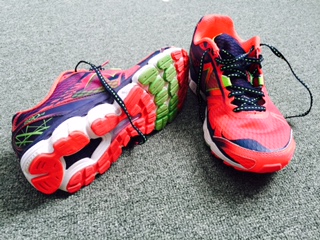
Recently my podiatrist sent me to a runners’ specialty store to purchase a pair of running sneakers for my plantar fasciitis pain. Unfortunately, there wasn’t a black sneaker in the store, so I bought the only ones that felt comfortable – a neon orange-pink pair with bright lime green accents. I walked around the house for two weeks before I gathered enough courage to go out in public with them.

.Sneakers

The first time my two-year-old grandson saw me wearing those neon colored sneakers his eyes popped and he pointed to my feet, shouting, “What’s dat? What’s dat?”

“What’s what?” I asked, looking down at my feet. “Oh; these are my new sneakers.”

He ran over to me, squatted in front of my feet and gently poked the bright orange tops of the sneakers, letting out a longwinded “Ohhhhhh…”

That’s the feeling of joy I’m looking for when I assemble my pile of clothing and hold up each piece to ask myself, “Does this bring me joy?” If my answer isn’t a longwinded “Ohhhhhh,” I’ll toss it in an opaque bag and wait for nightfall.

Something tells me, by the time I’m done sorting my joyless clothing, my closet will be empty. But, for the first time in twenty years, I will be telling the truth when I say, “I have nothing to wear!”

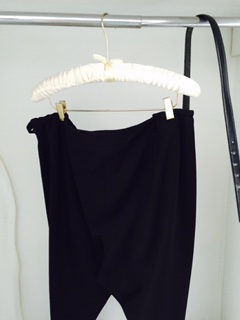
my empty closet

Posted in Uncategorized | Tagged , , , , , | 3 Comments